The Five-Minute Favour That Swallows an Hour
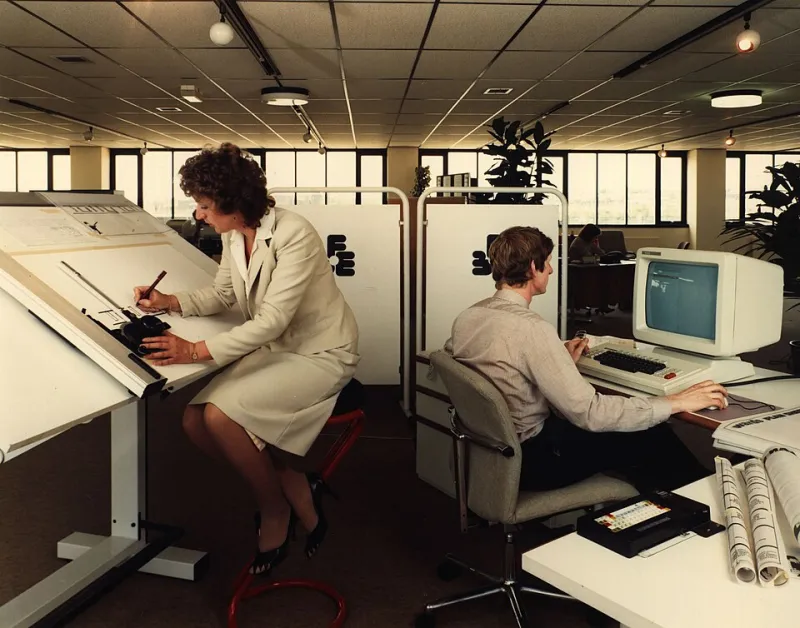
Photo: Tyne & Wear Archives & Museums, No restrictions, via Wikimedia Commons
It is 10:42 on a Tuesday. You are finally inside the document that has been staring back at you since half nine. Then a head appears over the partition, or a message lands with the familiar opener: 'Got a sec?' It is never a sec. It is a small question with a wide blast radius. You answer it, because you are a reasonable person and because saying no feels rude. By the time you look back at the document, the thread has gone cold and the kettle is calling.
This is not a story about annoying colleagues. Most people asking a quick question are trying to do the right thing. They are stuck, they need a nudge, and you happen to know the answer. The problem is not the question. The problem is the default route: every small ask arrives as an interruption, and every interruption is treated as free.
The invoice arrives later
A five-minute question does not cost five minutes. It costs the tail. There is the time to switch out of your work, the time to understand the ask, the time to answer, and the time to get back in. For anything involving concentration, that last part is the expensive bit. You do not simply resume; you reload the mental model you had built. The tabs in your head have to be reopened one by one.
If you field six of these before lunch, you have not lost half an hour. You have lost the shape of the morning. The work still gets done, but it gets done in the gaps between interruptions, which is a tiring way to operate. It also makes the day feel longer than it is, because the finish line keeps moving.
Why the small ask feels free
On a chat app, a question looks weightless. There is no stamp, no envelope, no walk to someone's desk. That is the point of the tool, and it is also the trap. The easier it becomes to ask, the more likely we are to ask before we have tried to work it out ourselves. The cost does not disappear; it just moves to the person on the other end.
British workplace politeness makes this harder. We are quite good at softening the ask, and quite bad at protecting the time needed to answer it properly. 'Sorry to bother you' is a lovely sentence, but it does not change the arithmetic. The colleague who says yes to everything is often the one whose own work gets pushed into the evening.
The default is the problem, not the question
A useful reframe: not every question deserves a meeting, a call, or even an immediate reply. Some questions need a quick answer. Some need a shared document. Some need a conversation. Some can wait until Thursday. The trouble is that most teams have one route for all of them, and that route is usually a direct message.
A better setup gives questions lanes. A shared question channel is one lane: ask in the open, let whoever knows answer, and leave a searchable trail for the next person. Office hours are another: a predictable window when someone is available for the small stuff, so the rest of the day can be protected. A short FAQ or pinned note is a third: the answers to the questions that come up every fortnight, written down once.
None of this is about banning questions. It is about making the path of least resistance a little less disruptive.
Give the small stuff somewhere to go
Start with one shared channel for questions that do not need a private audience. Call it what it is: team questions, ask-away, the help desk, whatever fits. The point is that asking there becomes normal, and answering there becomes a shared act rather than a personal favour. It also means the next new starter can search the answer instead of interrupting the same person again.
Then add a simple office-hours block. It does not need to be fancy. A thirty-minute slot twice a week, listed in the calendar and respected by the team, gives people a place to bring the odds and ends. Outside that block, direct messages are still fine for urgent things, but the default for small asks shifts. You are not unavailable; you are just not always available.
In a tool like Kula, that can be as simple as a shared question channel, a pinned office-hours note, and a status that tells people when you are in focused work. The technology is not the hard part. The hard part is agreeing that the arrangement is fair.
A gentle boundary that does not sound like a door closing
If you are the person constantly interrupted, try a script that buys time without implying the other person has done something wrong. Something like: 'I can help with that. I am in the middle of something until 11:30, so I will pick it up then unless it is urgent.' It is warm, it is clear, and it gives the asker a chance to say whether it really cannot wait.
If you are the asker, try adding the context up front. 'No rush, but do you know where the latest brand guidelines live?' is easier to answer asynchronously than a bare 'Got a sec?' The extra sentence saves a round trip and shows that you respect the other person's attention.
Measure the right thing
Do not turn this into a surveillance exercise. The aim is not to count messages or shame anyone for asking. The aim is to notice patterns. Are the same three questions landing every week? Then the answer belongs in a shared note. Is one person always the human search engine? Then the team has a documentation gap, not a dedication problem. Is the afternoon full of small pings? Then the office-hours slot is in the wrong place.
A team that routes small asks well does not become silent. It becomes calmer. People still ask for help, but they ask in a way that lets the answer land at a sensible moment. The quick question stops being a tax on whoever happens to be online, and starts being part of how the team works together.
That is a better deal than another 'got a sec?' at 10:42.