Friday, Interrupted: Designing Your Collaboration Stack for a Four-Day Week
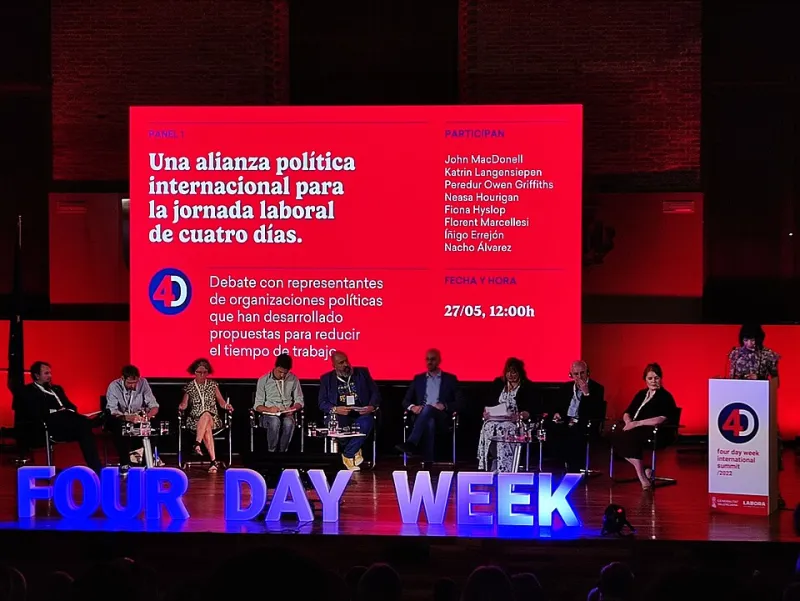
Photo: Francesc Fort, CC BY-SA 4.0, via Wikimedia Commons
The four-day week is usually sold as a calendar change. In practice, it is a collaboration redesign. When a team drops a day, the work does not politely shrink to fit. The meetings, handovers, approvals and quick questions all have to go somewhere. And if you do not redesign the system, they go into Thursday afternoon and Monday morning with a vengeance.
The UK has a useful history here. In 2022, more than 60 UK companies took part in a six-month four-day-week pilot coordinated by 4 Day Week Global, Autonomy and the 4 Day Week Campaign. The headline results, published in 2023, were encouraging: most participating firms chose to keep the shorter week, revenue held steady for many, and resignations fell. That is genuine history, and it matters. But the trials focused mostly on output and wellbeing. The practical question for 2026 teams is narrower and more awkward: what happens inside the tool stack when Friday disappears?
The calendar does not shrink. It compresses.
The first thing to go is usually the meeting. Recurring status updates get cancelled. All-hands move to a monthly cadence. One-to-ones are shortened or pushed together. That sounds efficient until you notice what is happening: the same number of decisions are being made in fewer slots, and the slots themselves are fuller.
Compression becomes congestion. Thursday turns into a second Friday. The team that was supposed to finish at lunchtime is still on a call at 4pm because 'we just need to clear a few things before the weekend'. The day off exists on paper, but the pressure has simply moved.
The fix is not to cram harder. It is to decide what the four-day week is for. If the fifth day is genuinely non-working, it needs to be a hard boundary in the calendar, not a soft hope. That means no internal meetings on the day off, no 'quick favour' messages, and no expectation that people will check in just because they can.
Async stops being a nice-to-have
When Friday disappears, handovers have to survive a longer gap. A question asked at 4pm on Thursday may not be answered until Monday. That is fine if the team has written things down. It is not fine if the answer lives in someone's head.
This is where async habits become mandatory rather than fashionable. A written update is no longer a bureaucratic extra; it is the thing that keeps the project moving while people are offline. A recorded walkthrough is not a substitute for a meeting; it is the meeting, with the added benefit that people can watch it at 9am on Monday instead of 4pm on Thursday.
The teams that handle this well tend to have three small habits:
- A weekly written update that says what moved, what is stuck and what needs a decision.
- A decision log that records what was agreed, by whom and when — so nobody has to reconstruct the conversation from memory.
- Clear channel purposes so that urgent operational questions do not get buried in a general chat channel.
Async is not 'email after hours'. It is a deliberate default that protects the day off and makes the other four days calmer.
The meeting rhythm gets leaner and more decisive
A four-day week exposes every meeting that exists because it always has. The ones that survive tend to be shorter, better prepared and explicitly tied to a decision. That is not a coincidence. When time is scarce, meetings have to earn their place.
A few practical moves work well in UK teams:
- Default to 25 or 50 minutes rather than 30 or 60. The extra five minutes are usually padding.
- Require a pre-read for anything that needs a decision. If nobody has read it, the meeting becomes a reading club.
- Name the decision owner in the invite. 'We need to agree X' is better than 'catch-up'.
- Replace the Friday catch-up with a Monday async digest. People can read it when they start, not when they are already tired.
What you should not do is move every Friday meeting to Thursday. That is not redesign; that is displacement.
Where the pressure quietly returns
Even teams that cut meetings often reintroduce the pressure through the tool stack. The usual suspects are predictable:
- The Thursday crunch. Work gets front-loaded into the last available day. The fix is to spread deadlines across the week and to stop treating Thursday as a mini-Friday.
- The Monday backlog. The inbox and chat channels fill up over the long weekend. The fix is not to read messages on the day off; it is to set expectations that Monday morning starts with a digest, not a scramble.
- Notification creep. More async tools mean more places to check. Without notification budgets, the day off becomes a low-level hum of 'I'll just glance at it'.
- Tool sprawl. If every team adds its own async video tool, whiteboard and task tracker, the four-day week becomes a four-day tour of nine apps. Consolidation is a productivity move, not just a procurement one.
A practical stack checklist
Treat the four-day week as a design constraint. Then ask what the tools need to do:
- Calendar: publish the team's non-working day, block focus time and make internal meetings fit the four-day pattern.
- Chat: agree response times, channel purposes and an escalation route for urgent work.
- Docs: keep a single decision log and a weekly written update that anyone can read asynchronously.
- Meetings: use 25/50-minute defaults, pre-reads and a named decision owner.
- Project tool: keep one source of truth for tasks and deadlines, and review it weekly rather than constantly.
- Notifications: schedule them. Real-time alerts for everything are incompatible with a shorter week.
A tool like Kula can support this with shared docs, threaded updates and async check-ins, but the tool is not the policy. The policy is the hard boundary, the written handover and the decision that Thursday is not a second Friday.
Measure the right things
If you want to know whether the four-day week is working, do not just measure output. Measure the collaboration load. How many meeting hours does each person have? How long does it take to get a decision? How many messages are sent outside working hours? How big is the Monday backlog? What percentage of decisions are written down?
Review those numbers monthly. If Thursday is consistently the most stressful day, the problem is not the people. It is the design. The teams that do the four-day week well do not squeeze five days into four. They redesign the work so that four days are enough.